
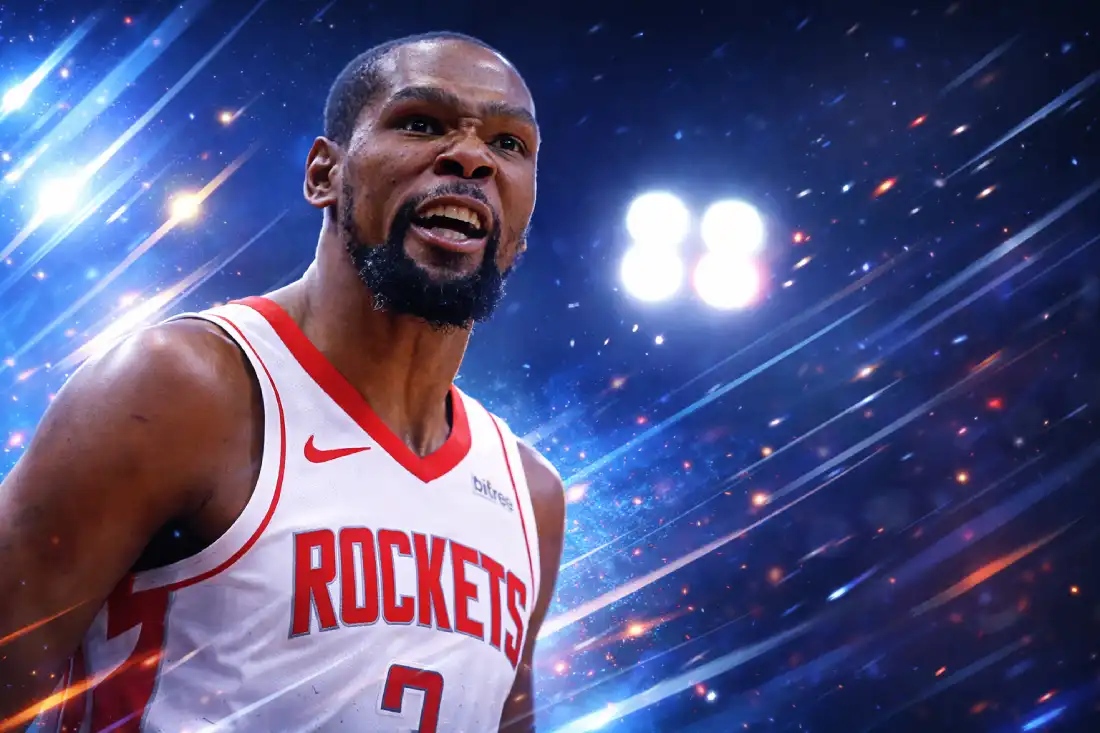
In the hallowed halls of basketball history, there are names that feel untouchable. For decades, Michael Jordan’s place in the top five of the all-time scoring list felt like a permanent fixture of the sport’s landscape. But in a stunning performance in Houston, the “Slim Reaper” himself, Kevin Durant, officially leapfrogged “His Airness” to claim the No. 5 spot on the NBA’s career scoring chart.
For Durant, now 37, the climb has been a steady, 19-year masterclass in efficiency. Achieving this level of hoops immortality isn’t just a testament to his talent; it is a flex of longevity that few in the history of the Association have ever matched. “It’s pretty cool to be in the same category as some of the greats,” Durant remarked after the game. For a player who grew up watching Jordan’s final years in Washington D.C., the moment was a perfect “basketball storm” of childhood inspiration meeting veteran dominance.
The Anatomy of a Scoring Savant
What makes Durant’s rise into the top five so distinct is his “positionless” lethality. Standing nearly 7 feet tall with the handles of a point guard, Durant is among the handful of elites who can score in a variety of ways: at the rim, mid-range, off the dribble, or as a catch-and-shoot threat. This diversity has allowed him to remain a nightmare for defenders for almost two decades.
Perhaps most impressive is Durant’s trademark efficiency. Despite playing alongside other high-volume scoring champions like Stephen Curry, Russell Westbrook, and Devin Booker, Durant has never averaged less than 25 points per season since his sophomore year. His career shooting percentage of 50.3% is a rarity for a perimeter-oriented player, proving that he doesn’t take shots away from his teammates—he simply makes the ones he takes count. Had he not missed the 2019-20 season due to Achilles surgery, this milestone likely would have arrived even sooner.
Context and the Evolution of the Game
While Durant’s skill is undeniable, his ascent also reflects a massive shift in how professional basketball is played. The modern era provides offensive players with significantly more freedom and space than the “hand-checking” days of the 1990s. Several factors have accelerated the scoring totals of today’s superstars compared to legends of the past:
- The 3-Point Revolution: The emphasis on distance shooting gave Durant a weapon that wasn’t fully embraced by previous generations. Durant will likely overtake Jordan on the list despite attempting over 2,000 fewer shots, largely due to the math of the three-pointer.
- Vanishing Interior Defense: The traditional “post-up” big man has largely disappeared, opening up the lane for wing players to operate with less physical resistance at the rim.
- Rule Interpretations: Changes in officiating, such as the outlawing of hand-checking and the acceptance of the “gather step” and “step-back,” have made it easier for offensive players to create separation.
- Longevity Science: Modern training, recovery, and sports medicine allow stars like Durant to maintain their peak production well into their late 30s—a feat that was physically impossible for most players in the 20th century.
The Path to No. 1: Can Durant Catch the Leaders?
With Michael Jordan now in his rearview mirror, Durant’s sights are set even higher. The road ahead remains daunting, but for a man who “just wants to hoop,” no record feels entirely out of reach. His next target is the legendary Kobe Bryant, a milestone he is projected to reach as early as next season.
Beyond Bryant sits the “Mount Rushmore” of scoring: Karl Malone, Kareem Abdul-Jabbar, and the current record-holder, LeBron James. Catching Abdul-Jabbar would require Durant to maintain his current 25 PPG average into his 40s—a feat of endurance that Durant himself acknowledges is “setting the bar high.” However, with no sign of a production drop-off in sight, the basketball world has learned never to bet against Kevin Durant. As long as the legs hold up, the scoring will continue, and the history books will keep needing fresh ink.